
Edge AI is Here - And It's not Running in the Cloud
A clear, practical guide to India's Edge AI opportunity and the skills embedded and AI engineers need to build for it.
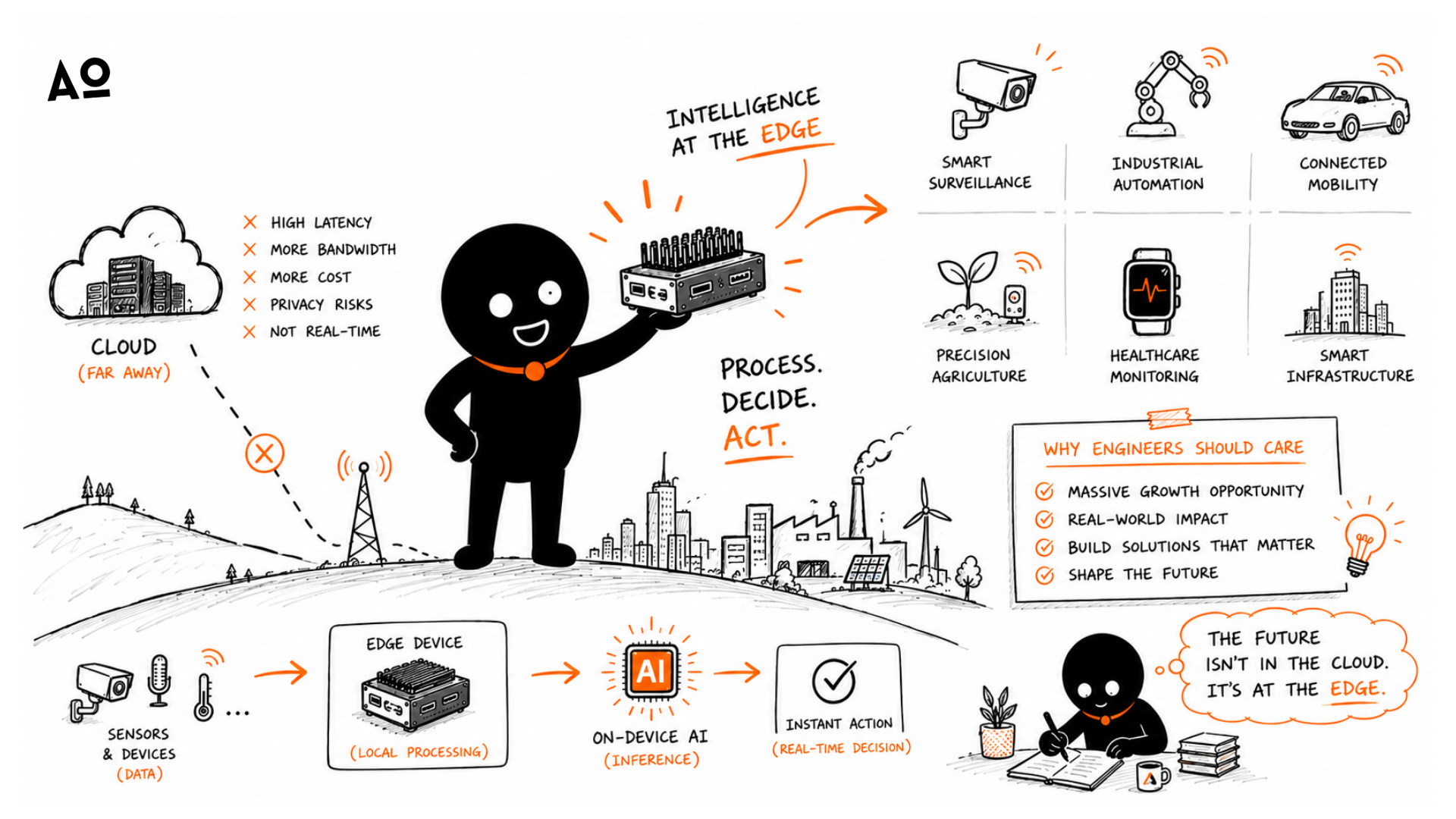
India's Edge AI market is growing fast. This guide explains what that means for engineers, where the demand is coming from, and what skills to build next.
If you’ve followed AI news for the last few years, you’ve mostly heard about one kind of AI: big language models, running on huge servers, accessed through the internet. ChatGPT. Cloud APIs. That world is real and it matters.
But there’s a second, quieter kind of AI that’s been growing at the same time — AI that lives inside things. Cameras. Machines on a factory floor. Cars. Medical devices. Sensors out in a field. This is called edge AI, and unlike the first kind, it doesn’t need the internet to work. The “thinking” happens right there, on the device itself.
If you’re an engineer in India — whether you build embedded systems, work in IoT, or you’re coming from an AI/ML background — this is genuinely worth your time. Not because some market report says so (reports say that about everything). It’s worth your time because the hardware has actually caught up, the tools have gotten easier to use, and the kind of problems India needs to solve fit this technology unusually well.
Let’s slow down and go through this properly, the way I’d explain it if you were a fresher sitting across the table from me.
What is Edge AI?
Here’s the simplest way to think about it.
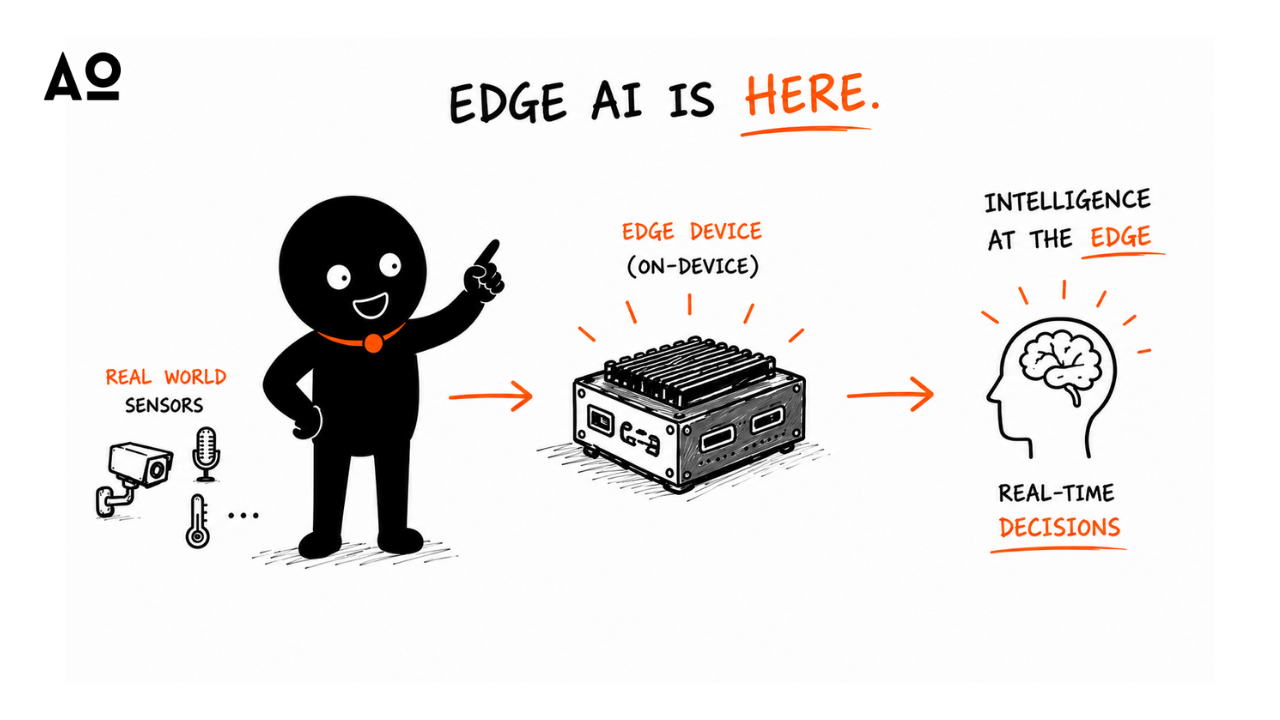
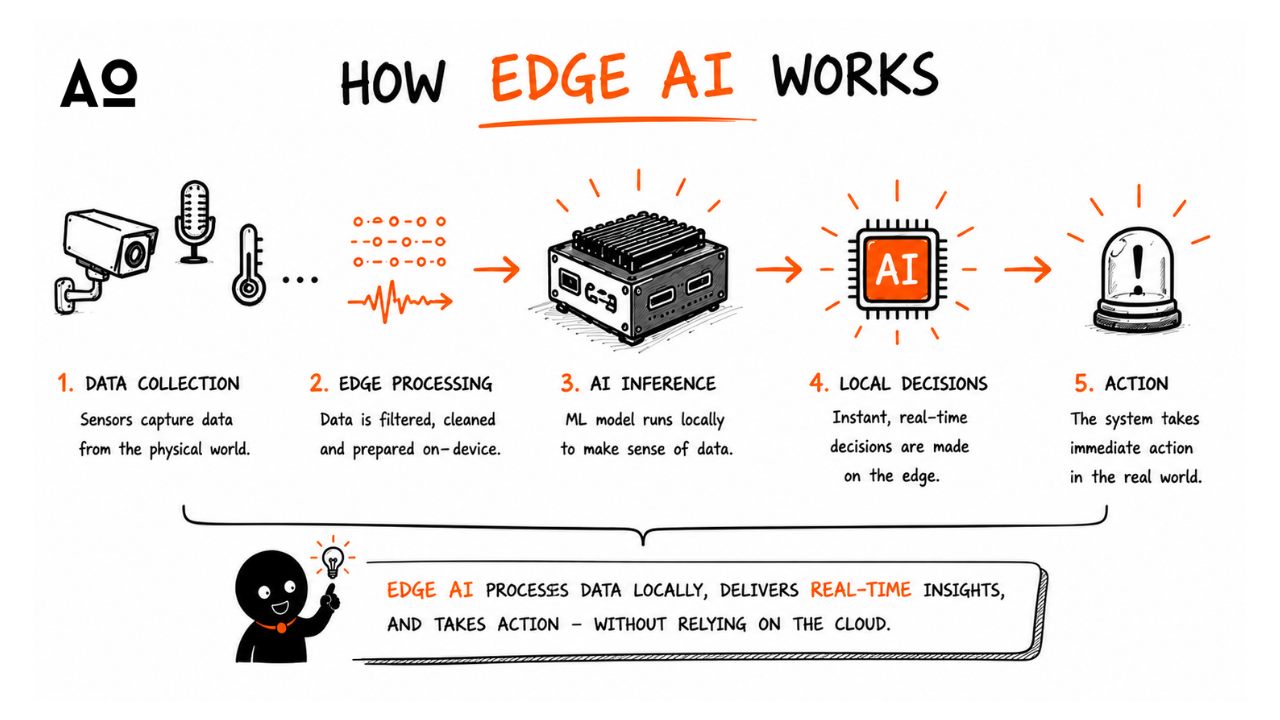
Normally, when an app or device uses AI, it works like this: the device collects some data (say, a photo from a camera), sends that data over the internet to a powerful server somewhere far away, that server runs the AI model and figures out the answer, and then sends the answer back to the device. That round trip takes time, and it only works if the internet connection is good.
Edge AI skips the round trip. Instead of sending the photo away and waiting for an answer, the device itself runs a smaller AI model and figures out the answer on the spot.
So instead of:
Camera → Internet → Faraway Server → AI Model → Answer → Back to Device
it becomes:
Camera → Small Chip Inside the Device → AI Model → Answer, immediately
The cloud doesn’t disappear completely — it can still be used later for things like storing data, retraining the model, or managing thousands of devices at once. But the immediate decision — “is this part defective?”, “is a person in the frame?”, “is this machine about to break?” — happens right there on the device, in a fraction of a second, whether or not the internet is even working.
Think about why that matters. A machine catching a mechanical failure before it breaks down. A car spotting a pedestrian crossing the road. A security camera noticing someone climbing a fence. A smartwatch noticing an unusual fall. In every one of these cases, you don’t want the device thinking “let me just check with the cloud first.” Sometimes a few hundred milliseconds is the difference between useful and useless. Sometimes there’s no internet connection at all. Sometimes sending the raw video or audio out of the device isn’t something you’re even allowed to do.
That’s the whole idea behind edge AI. Nothing more mysterious than that.
Why this is a big deal right now
Engineers have actually been running small AI models on tiny chips for a few years already — this isn’t brand new. What has changed, and changed quickly, is how powerful the chips available to an ordinary developer have become.
Here are a few real examples, explained simply:
- STMicroelectronics released a chip called the STM32N6. This is a microcontroller — the same category of cheap, low-power chip used in everyday electronics — but this one has a dedicated section built just for running AI models, and it’s fast enough to do real-time computer vision. A few years ago, “computer vision on a microcontroller” would have sounded like a joke. Now it’s a normal product you can buy.
- Arm (whose chip designs sit inside a huge share of the world’s electronics) has been building tools that make it much easier to run AI models on these small chips, without needing to be an AI expert to do it.
- Texas Instruments now has a dedicated toolkit — they call it Edge AI Studio — specifically to help engineers put AI models onto their microcontrollers.
- Qualcomm has been doing this at a bigger scale, with more powerful chips that can run richer AI models, and they’ve built a workflow (through a platform called Edge Impulse) that takes you from “I have some data” to “my model is running on the chip,” without needing a PhD to get there.
- NVIDIA has gone even further, with a chip called Jetson Thor, aimed at robots — powerful enough to run large, complex AI models directly on the robot itself, in real time.
So today, “edge AI” isn’t one thing. It’s a whole spectrum, from a tiny, cheap sensor running a very small model, all the way up to a robot running something close to a mini data center. Every point on that spectrum is a genuinely different engineering problem, with its own limits on memory, power, and speed. That’s exactly why this shouldn’t be treated as “just another AI skill to learn.” It’s closer to a whole new engineering discipline that happens to include AI as one part of it.
Why India is a good place to be doing this
One market research estimate puts India’s edge AI market at around $1 billion in 2025, and expects it to grow to around $7.5 billion by 2033. Take that number the way you’d take any forecast — a reasonable guess, not a guarantee. But here’s a detail buried inside that report that I find far more useful than the headline number: roughly two-thirds of that revenue is coming from hardware, not software.
What that tells you is simple: this isn’t only a “write some Python code” story. It’s a story about chips, cameras, sensors, gateways, vehicles, and factory equipment — and India already has a huge amount of engineering talent working in exactly those areas.
On top of that, India’s government has been actively investing in building semiconductor design capability at home, through programs that specifically support things like video surveillance systems, drone detection, energy metering, and IoT chips — all of which overlap directly with edge AI. In other words, India’s push to build more chips domestically and India’s push into AI aren’t really two separate stories happening at the same time by coincidence. AI has to physically run somewhere, and a good chunk of that “somewhere” is starting to be designed and built here.
So why not just use the cloud for everything?
Good question, and worth answering honestly — because the cloud genuinely is the right choice a lot of the time. If you’re running something that isn’t time-sensitive, the cloud is usually cheaper, easier to update, and easier to maintain. Edge AI isn’t about replacing the cloud everywhere. It’s about knowing when sending everything to the cloud is actually the wrong engineering decision. There are five recurring reasons that happens.
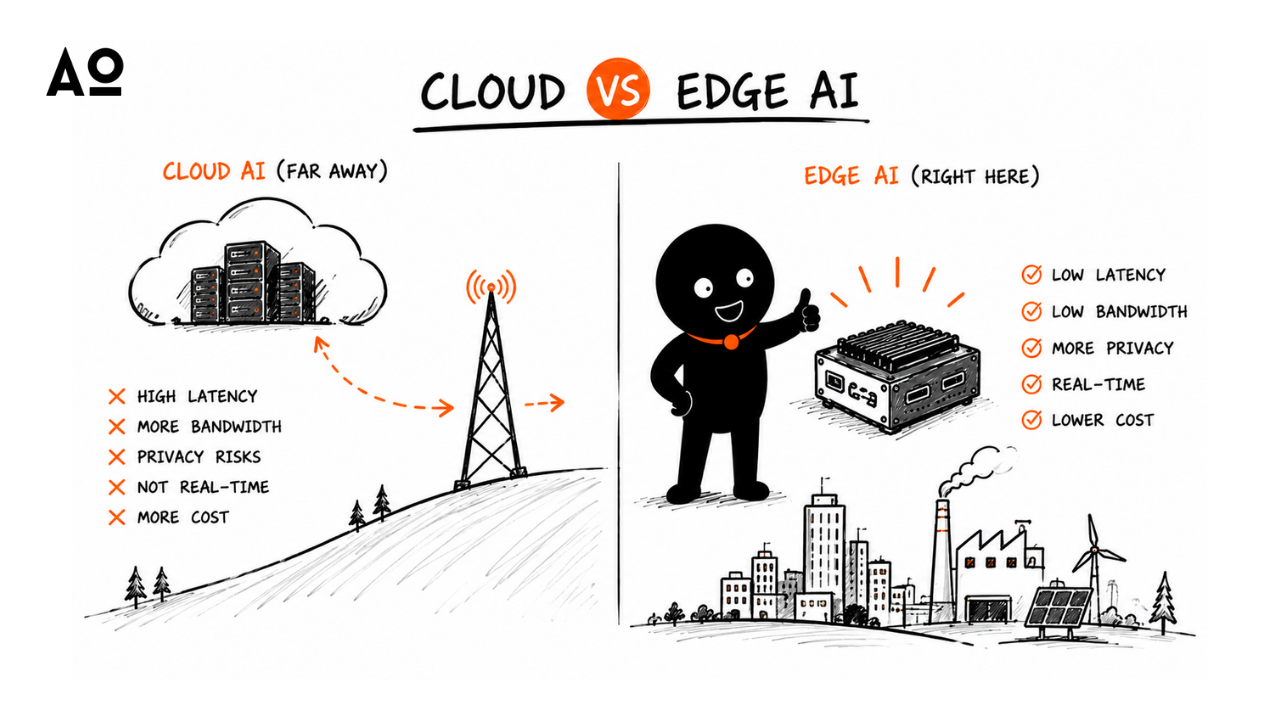
1. Speed (latency). Imagine a camera watching a production line, checking each part for defects. If a bad part needs to be rejected in real time, you can’t afford to send the photo away, wait for a server to reply, and then act. By the time the answer comes back, the part has already moved past the rejection point. Do the check on the device itself, and the decision happens instantly.
2. The internet isn’t always there. Anyone who’s actually built a real IoT product learns this the hard way: networks fail. Wi-Fi drops. SIM cards lose signal. Routers hang. Even cloud services go down sometimes. If your device becomes “dumb” the moment its internet connection drops, that’s a fragile design. A device that can keep working — and think for itself — even when it’s completely offline, is a much more dependable one.
3. Privacy. Think about a camera watching a workplace for safety, or a device inside a car watching the driver, or a health monitoring device. Do you really need to send every single photo or every second of audio out of the device? Often, no — the device can just decide locally, “yes, a person is here,” or “that sounded like glass breaking,” and only send that small piece of information onward, instead of streaming someone’s private video or audio to a server.
4. The cost of moving data. Now imagine you have a hundred cameras, or a thousand sensors, or fifty thousand connected devices. Sending raw video or raw sensor readings from all of them, all the time, gets expensive very quickly — in bandwidth, in storage, in money. But sending a short message like “there’s a 93% chance this bearing is about to fail” is a tiny fraction of the size of the full data behind that decision. Do the thinking locally, and you only need to send the conclusion.
5. Battery life. This one matters a lot if you come from an embedded background already. Turning on a radio, connecting to a network, sending data, and waiting for a reply — all of that uses a surprising amount of power. A battery-powered sensor doing this constantly can drain far faster than one that runs a small AI model locally and only “phones home” occasionally with a result. Sometimes the reason you run AI on the device has nothing to do with AI itself — it’s simply the difference between a battery that lasts twelve months and one that lasts twelve days. That’s a classic embedded engineering problem. AI has just become part of solving it.
Where you’ll actually see this in India
A few areas stand out clearly as places this is already happening, not just theory.
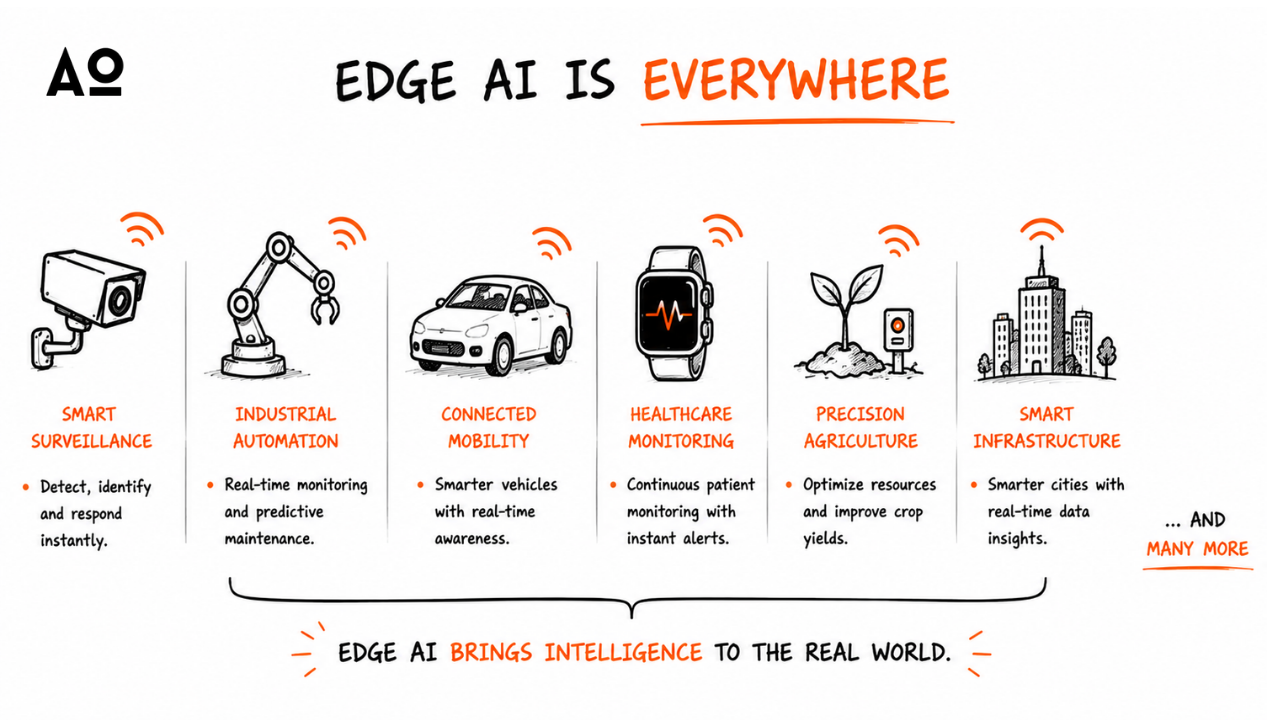
Manufacturing. As India makes more electronics, vehicles, and industrial equipment domestically, factories are generating huge amounts of real-world data — vibration, sound, temperature, video — and a lot of the useful decisions need to happen right there on the factory floor. A camera checking a part for defects and rejecting it instantly. An accelerometer picking up early signs a motor bearing is about to fail. A microphone listening for the specific sound a machine makes just before it breaks. None of these are pure “data science” problems — they need someone who understands sensors, timing, memory, and how to actually deploy something that keeps working on a factory floor, which is exactly the kind of problem embedded engineers are already good at.
Automotive. Modern vehicles are turning into small computer networks on wheels — driver-assist features, driver monitoring, voice control, predictive maintenance. Almost all of it needs to run locally, because a moving car can’t afford to wait on a cloud server to tell it whether to brake. Indian roads and Indian cost constraints also mean you genuinely can’t just copy a model built for a different country’s conditions and expect it to work here — it has to be built and tuned for the environment it will actually run in.
Video and camera systems. This is already a live example — an Indian video-security company, CP PLUS, has partnered with Qualcomm to build camera systems that do AI processing right at the camera. That opens up things like counting people, detecting intrusions, spotting fires or smoke, and reading number plates — all done at the camera, sending back only the useful result instead of a constant video stream.
Agriculture. This one might be the most underrated fit, because farms have exactly the conditions edge AI is built for: patchy or no internet, limited power, and devices spread out over a wide area. A field device with a camera and some basic sensors could detect crop disease, identify pests, or help decide when to irrigate. The hard part isn’t training the model — it’s making the whole thing survive heat, dust, rain, and months without a service visit. That’s where a nice AI demo turns into real engineering.
If you’re an embedded engineer, or an AI engineer
Here’s something worth saying clearly, because I think a lot of embedded engineers don’t realize how well-positioned they already are.
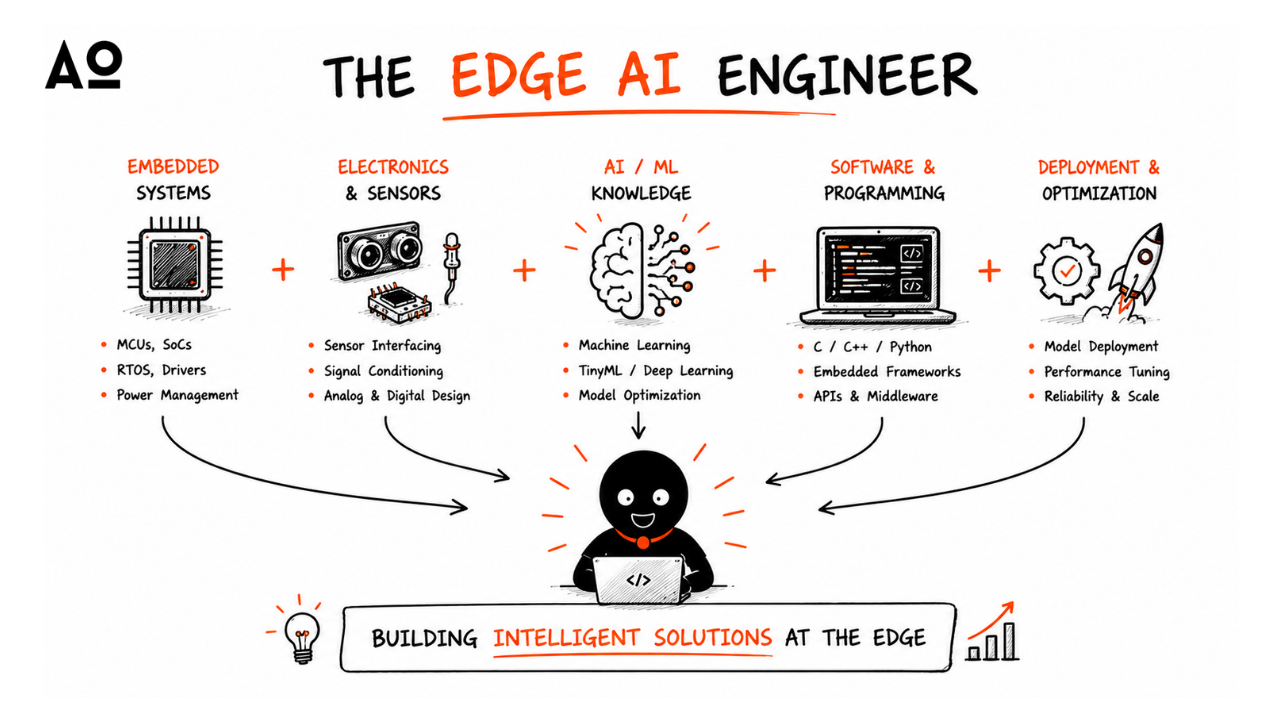
AI engineers are usually good at building and training models. Embedded engineers are usually good at working within tight limits — memory, power, timing. Edge AI is really the art of combining both: making a model that actually works within those limits. If you already know how to think about RAM, flash storage, timers, interrupts, and power management, none of that becomes useless once AI enters the picture — it actually becomes more important than ever.
If someone hands you an AI model and asks you to put it on a small device, the real engineering questions start immediately: How much memory does this model need? Can the chip even hold it? How fast does it need to run? What happens if the model gives a wrong answer, or the sensor gives noisy data? How would you even update the model later, without physically visiting every single device? That entire set of questions is edge AI engineering — not just calling a model.predict() function in Python.
Now, if you’re coming from the AI/ML side instead — comfortable with training models in PyTorch or TensorFlow, but new to hardware — the gap runs the other way, and it’s worth naming honestly. A model that works beautifully on your laptop can completely fail to fit on a real device. Suddenly, accuracy isn’t the only thing that matters anymore. You start having to care about how much memory the model takes up, how much power it uses per prediction, and how fast it runs — because a model that’s 94% accurate but too big to fit on the chip is useless, while a slightly-less-accurate model that actually runs on the device is the one that ships.
This is exactly why a technique called quantization is worth learning properly, even as a fresher. In simple terms, quantization means shrinking a model down — making its internal numbers take up less memory — so it can fit and run faster on smaller, cheaper chips. It sounds like a small technical detail, but it’s often the single most useful skill for making AI actually work on real hardware, and it’s the one thing that trips up almost everyone the first time: your model works perfectly, you shrink it down, and suddenly its accuracy drops. Learning to understand and fix that is a genuinely valuable, learnable skill — and the good news is that companies like ST and Qualcomm have built tools that make this process much easier than it used to be, so you don’t need to reinvent it from scratch.
How to actually learn this, step by step
If you’re starting from zero, don’t try to learn everything at once, and don’t buy ten different development boards hoping one of them sticks. Build depth, one stage at a time.
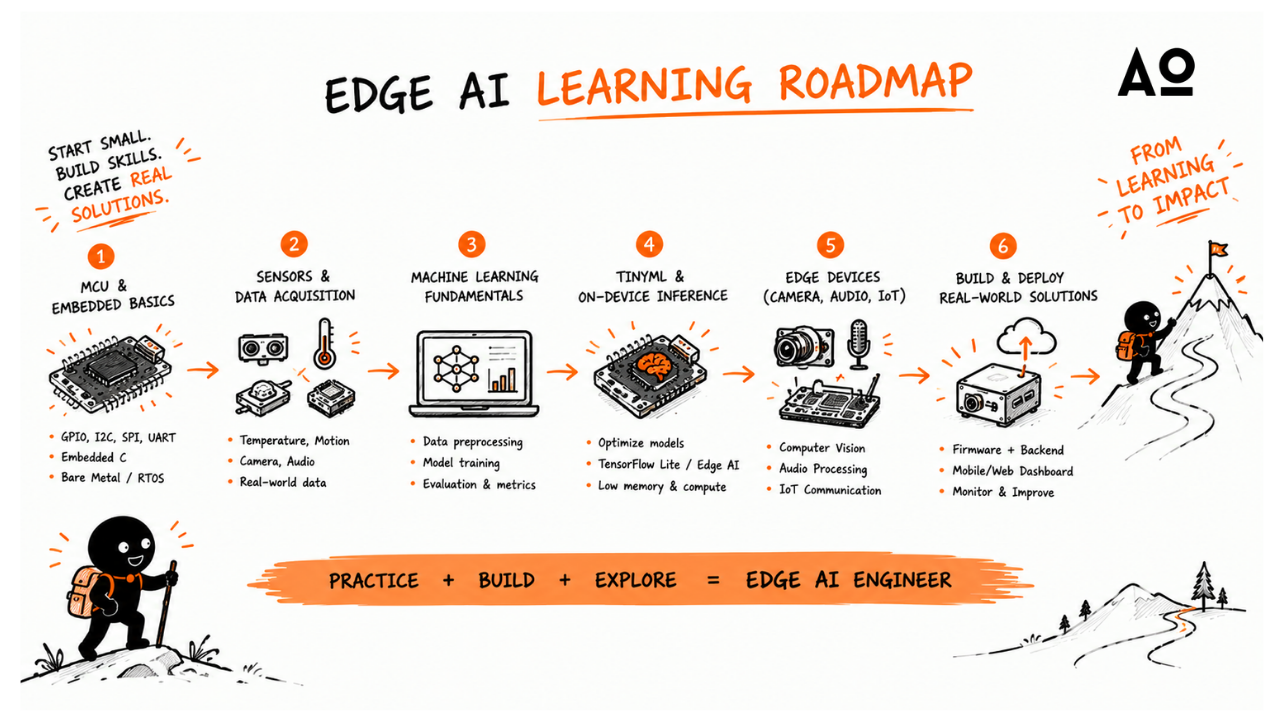
- Learn one microcontroller properly. Pick either ESP32 or STM32 — both are good, well-documented choices — and actually get comfortable with the basics: C/C++, reading sensors, timers, interrupts, and how the board manages power. This is your foundation. Don’t skip it to jump straight to AI.
- Learn the basics of machine learning. You don’t need to become a researcher. You just need to understand, in practical terms, what a model is, how it’s trained, and how to tell if it’s actually working well (accuracy, and where a model gets things wrong). Python, plus a beginner-friendly framework like PyTorch or TensorFlow, is enough to start.
- Try TinyML — a small, complete project. Something simple, like using an accelerometer to detect a type of movement, or a microphone to recognize a specific sound. Walk through the whole journey: collecting data, training a small model, shrinking it down (quantizing it), and getting it running on your chip. Doing this once, start to finish, will teach you more than a month of reading.
- Add a camera. Once you’re comfortable, move on to something visual — detecting a person, classifying an object, spotting a defect. This is where you’ll really start feeling the memory and speed limits of real hardware, which is exactly the experience you need.
- Move up to more powerful devices. Try something like a Raspberry Pi or an NVIDIA Jetson, where you have more room to work with, and learn the tools used at that level — things like ONNX and Docker — so you can build more capable applications.
- Build one complete product, start to finish. This is the step most people skip, and it’s the one that actually matters most. Don’t stop at “the model can detect a person.” Take it all the way: camera captures something, the model makes a decision, that decision gets sent somewhere useful, and there’s a simple dashboard or app showing what’s happening — with a way to update the model later without physically touching the device. That complete loop is what makes a good interview story, and possibly something a real customer would actually pay for.
Five projects that will teach you more than any course
If you want a portfolio that actually stands out, build systems, not notebooks. Here are five ideas, roughly in order of difficulty:
- A vibration monitor for machines. Attach an accelerometer to a small motor, run a simple model that spots unusual vibration patterns, and send an alert. Measure not just accuracy, but how fast it runs and how much power it uses.
- A visual quality checker. Use a camera and a small object-detection model to spot defective parts and reject them automatically. Try running the same model in different sizes (called FP32, FP16, and INT8 — different levels of “shrinking”) and compare how each one performs.
- A smart security camera. Instead of streaming continuous video, have it detect people or vehicles locally and only send a short alert when something happens.
- An offline voice command device. Build something that recognizes a wake word and a few simple commands, completely without any internet connection. No cloud assistant involved at all.
- A small edge AI gateway. Connect a few sensors or cameras to one device that does the thinking locally and sends results up to a simple dashboard, and then add the ability to update the model remotely, without needing physical access. That last part — being able to manage and update a model that’s already deployed out in the field — is what separates a serious project from a college demo.
The engineer companies are actually short of
Companies aren’t just looking for “an embedded engineer” or “an AI engineer” anymore. What’s genuinely hard to find is someone who can move comfortably across the whole chain — from the physical sensor, through the AI model, all the way to how it gets deployed and updated in the real world:
sensor or camera → signal processing → AI model → shrinking the model to fit → running it on the chip → getting data out reliably → showing it somewhere useful → keeping it updated over time
Major chip companies — ST, TI, Qualcomm, NXP, Infineon, Renesas, and others — are all actively building for this space right now. What’s harder for them than finding one more person who can train a model is finding someone who understands that entire chain reasonably well, end to end. That gap is the actual opportunity.
India’s engineering culture is already good at building for tough constraints — low-cost hardware, unreliable connectivity, harsh environments, devices that need to run for years without anyone visiting them. Edge AI doesn’t remove any of those constraints. It works inside them. And there’s real, lasting value in being the engineer who can take a model that already exists and make it run reliably on a cheap board, cut its response time down, shrink its memory footprint enough to remove an expensive chip, or figure out why something that worked perfectly in testing starts failing months later in a hot, dusty factory. None of that is glamorous work. All of it is exactly the kind of work this field is going to keep needing, for a long time.
References & Further Reading
- Grand View Research — India Edge AI Market Size & Outlook, 2026–2033 — market size, hardware/software split, growth forecast
- India Semiconductor Mission — ism.gov.in — official information on India’s semiconductor design and manufacturing ecosystem
- PIB — Design Linked Incentive Scheme — supported chip-design projects, including IoT SoCs and video surveillance
- STMicroelectronics — STM32N6 Series and ST Edge AI Suite
- Arm — Edge AI on Cortex-M and Ethos-U
- Qualcomm — On-Device AI Development, RB3 Gen 2 + Edge Impulse, Qualcomm + CP PLUS collaboration
- NVIDIA — Jetson Thor and Physical AI
- Texas Instruments — Edge AI Studio for Microcontrollers
Frequently asked questions
Is edge AI the same as TinyML?
Not quite. TinyML — running small AI models on microcontrollers — is one part of edge AI. Edge AI is the bigger umbrella, covering everything from a tiny model on a cheap chip to a large model running on a powerful robotics computer. TinyML is one room in a much bigger house.
I'm a fresher. Do I need to be great at machine learning to get into this?
No. You need to understand the basics of how a model works and how it's trained — not research-level math. What actually sets people apart in edge AI is understanding hardware limits: how much memory you have, how much power you can spend, how fast you need an answer. That's a learnable, practical skill, not a talent you're born with.
Should I start with ESP32 or STM32?
Either works fine. Don't overthink this choice. What matters far more is depth — pick one board, actually get good at it, and then add AI on top of that. Jumping between five different boards without going deep on any of them is the most common mistake beginners make.